
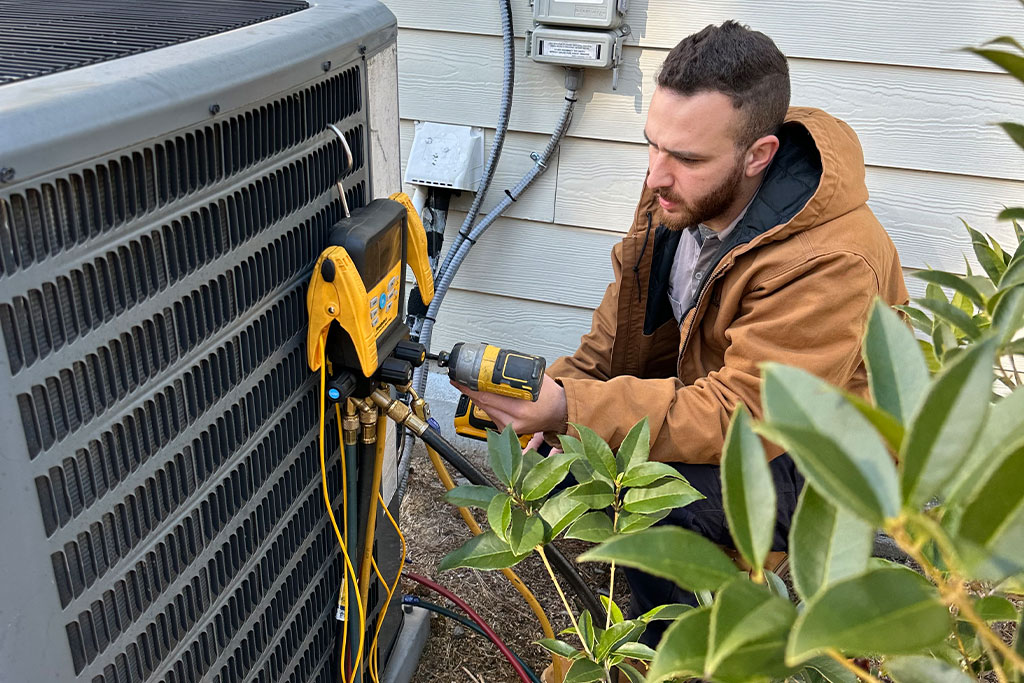
Professional Heating System Repair in Chapel Hill, NC
Your furnace quit on a 28-degree January night. The thermostat says 72, but the house feels like 55 and dropping. You don’t need a sales pitch right now — you need somebody who can get your heat running again. That’s what we do at Triangle Backflow, Heating & Air. We’re a locally owned, owner-operated heating repair company based right here in Chapel Hill, and we’ve been keeping Triangle-area homes warm since 2021. Give us a call or book online — we offer same-day heating repair service and free estimates on every job.
Why Your Heating System Isn’t Something to Gamble On
Here’s what we’ve learned after five years of residential heating repair across Wake County and Chatham County: most homeowners don’t think about their heating system until it stops working. And that’s understandable. A furnace or heat pump that’s running fine is invisible — you just set the thermostat and forget it. The problem is that small issues tend to snowball, especially during the stretch from late November through February when your system is running hard almost every day.
A worn igniter that’s slow to fire today becomes a no-heat call next month. A dirty flame sensor that causes the occasional short cycle in December turns into a furnace that won’t stay lit by January. We see this pattern constantly, particularly in older homes near UNC’s campus and throughout the Carrboro neighborhoods where the heating equipment has been running for 15, sometimes 20-plus years without much attention. Regular heating maintenance and a quick response when something feels off can save you hundreds — and a very uncomfortable night.
Heating Repair Services We Handle
We work on the full range of residential heating systems you’ll find in Triangle-area homes. That includes gas furnaces (which are still the most common setup we see in Chapel Hill, Durham, and Raleigh), electric furnaces, heat pumps, and dual-fuel systems. Here’s a closer look at what we repair and service every week.
Furnace Repair and Service
Furnace repair makes up a big chunk of our winter workload. The most common furnace problems we diagnose are failed ignition components (igniters, flame sensors, and hot surface ignitors), blower motor failures, cracked heat exchangers, and control board malfunctions. If your furnace is blowing cold air, short cycling, making unusual noises, or just refusing to kick on, those are all things we can typically diagnose and repair in a single visit. We carry common parts for Carrier, Lennox, Trane, Goodman, Rheem, Bryant, and York systems on our trucks, so most furnace repairs don’t require a second trip.
One thing worth mentioning — if we find a cracked heat exchanger, we’ll be straight with you about it. A cracked heat exchanger is a safety issue because it can allow carbon monoxide to leak into your home. We’re not going to patch that and move on. We’ll walk you through your options, whether that’s a heat exchanger replacement or a full furnace replacement depending on the age and condition of your unit. Honesty on stuff like that is non-negotiable for us.
Heat Pump Repair
Heat pumps have gotten very popular across the Triangle over the past several years, and for good reason — they’re efficient and they handle North Carolina’s mild-to-moderate winters well. But they come with their own set of repair issues that are different from a standard gas furnace. We regularly handle refrigerant leaks, defrost cycle failures, reversing valve problems, and compressor issues on residential heat pump systems. If your heat pump is icing over, stuck in cooling mode, or just not keeping up when temperatures drop into the low 30s, we can diagnose and repair it.
Here’s an insider observation: a lot of the heat pump “failures” we get called out for in Apex and Pittsboro neighborhoods like Briar Chapel and Fearrington Village aren’t actually mechanical problems. They’re thermostat configuration issues — the system is set up wrong for a heat pump, so the auxiliary heat never kicks in when it should, or the emergency heat runs constantly and drives the electric bill through the roof. That’s a 15-minute fix, and we don’t charge you for a major repair when it’s a settings adjustment.
Thermostat Repair and Replacement
Sometimes the problem isn’t your furnace or heat pump at all — it’s the thermostat. A failing thermostat can cause all kinds of confusing symptoms: short cycling, temperature swings, the system running nonstop, or the heat just never turning on. We troubleshoot thermostat and heating system connections as part of every diagnostic call. If you need a new thermostat, we install and configure smart thermostats (Nest, Ecobee, Honeywell Home) and standard programmable models.
Central Heating and Forced Air Repair
Forced air heating systems are by far the most common setup in residential homes across the Triangle. Beyond the furnace or heat pump itself, forced air systems can develop problems with ductwork (leaks, disconnections, crushed flex ducts in crawl spaces), blower assemblies, air handlers, and zoning dampers. We handle all of it. If you’ve got rooms that are always too hot or too cold, or you’re noticing weak airflow from certain vents, that’s worth having us take a look.
Boiler Service and Repair
Boilers are less common in this area than furnaces, but we do see them — particularly in some of the older homes in downtown Chapel Hill and parts of Durham near Duke’s campus. We service and repair residential boilers including circulator pump replacements, expansion tank issues, zone valve repairs, and pressure problems. If your radiators aren’t heating evenly or your boiler is cycling on the pressure relief valve, give us a call.
Signs You Need Heating Repair (Don’t Ignore These)
Some heating problems are obvious — the system just won’t turn on and the house is getting cold fast. But many issues show up as smaller warning signs first. Here’s what to watch for.
Your heater is blowing cold air or lukewarm air instead of consistent warm air. The system cycles on and off every few minutes without reaching the set temperature. You hear banging, rattling, squealing, or grinding sounds coming from the furnace or air handler. Your energy bill has jumped significantly without a change in usage. There’s a burning or musty smell when the heat runs. Some rooms are comfortable while others stay cold. The thermostat display is blank or unresponsive. You notice the furnace’s yellow or flickering flame instead of a steady blue flame (gas furnaces). Any of these warrant a professional diagnosis before a small problem becomes an expensive one.

Our Heating Repair Process — What to Expect When You Call
We know calling a contractor can feel like a gamble, so here’s exactly what happens when you reach out to us for heating repair.
First, you’ll talk to a real person — not a phone tree, not a call center in another state. We’ll ask you a few questions about what’s going on with your system so we can come prepared with the right parts and tools. Then we’ll schedule your visit, often same-day if you call in the morning, and we’ll give you a specific arrival window — not a vague “sometime between 8 and 5.”
When our technician arrives, they’ll do a full diagnostic of your heating system, not just look at the one symptom you described. We check electrical connections, test safety controls, inspect the heat exchanger (on gas furnaces), measure airflow, and verify thermostat operation. Once we know what’s wrong, we’ll explain it in plain English, give you an upfront price for the repair, and let you decide how to proceed. No pressure, no surprise charges.
Most residential heating repairs are completed during that first visit. If we need to order a part, we’ll tell you exactly how long it will take and we’ll get back out to you the moment it arrives. We stand behind our work with a warranty on all repairs — parts and labor.
Heating Maintenance: The Repair You Prevent Is the Cheapest One
This is the part where most heating pages try to scare you into buying a maintenance plan. We’re not going to do that. But we will tell you what we see in the field, and here’s the reality: the vast majority of emergency heating repair calls we respond to — easily 70% or more — involve systems that haven’t been serviced in two or more years. It’s a pattern that’s hard to ignore.
A heating tune-up and inspection once a year, ideally in the fall before the cold hits, catches the small stuff before it becomes the big stuff. Our heating maintenance service includes cleaning the burners or coils, checking the ignition system, testing the safety controls, inspecting the heat exchanger, checking refrigerant charge (heat pumps), verifying thermostat calibration, measuring airflow, and tightening electrical connections. It takes about an hour, and it’s the single best thing you can do to extend your system’s life and avoid a mid-winter breakdown.
For homeowners in the Meadowmont, Southern Village, and Governors Club communities — many of which have homes built in the early 2000s — your original heating equipment is now 20-plus years old. That’s right around the point where systems start needing more frequent repairs, and annual maintenance becomes especially valuable for catching problems early and helping you plan for an eventual replacement on your terms instead of on a Friday night in January.
What Does Heating Repair Cost?
We get this question on almost every call, and we understand why — nobody wants to commit to a service call without some idea of what they’re looking at. Here’s the honest answer: it depends on what’s wrong, but we can give you some real ranges based on what we see most often.
A standard diagnostic and service call runs between $89 and $129. Simple repairs like a flame sensor cleaning, thermostat replacement, or capacitor swap typically fall in the $150 to $350 range including parts and labor. Mid-range repairs like a blower motor replacement, igniter replacement, or control board repair usually land between $350 and $800. More involved repairs like a heat exchanger replacement or compressor repair can run $800 to $2,000 or more depending on the system.
We always give you an exact price before we start any work. No hourly rates that keep ticking while we troubleshoot. No surprise add-ons. If a repair costs more than it should relative to the value of your system, we’ll tell you that too. Sometimes the honest answer is that you’re better off putting that $1,200 toward a new system rather than sinking it into a 22-year-old furnace. We’d rather lose a repair sale and keep your trust.
We offer financing options for larger repairs and replacements, and we never charge overtime rates for evening or weekend emergency calls. Request a free estimate or call us now — there’s no cost to find out what’s going on with your system.
Repair or Replace? How to Decide
There’s no universal answer to this one, but here’s the general framework we use when helping homeowners decide. If your heating system is under 12 years old and the repair is under $500, repair it — that’s almost always the right call. If your system is over 15 years old and you’re facing a repair over $1,000, replacement starts to make a lot more financial sense, especially when you factor in the energy savings of a modern high-efficiency furnace or heat pump.
The gray area is everything in between. A 14-year-old furnace that needs a $700 blower motor? That’s a judgment call, and it depends on the overall condition of the system, how well it’s been maintained, and how long you plan to stay in the home. We’ll give you our honest recommendation, but the decision is always yours. If you want a second opinion on a repair quote from another company, we’re happy to provide one — no charge for the conversation.

Why Triangle Homeowners Choose Us for Heating Repair
There are plenty of HVAC companies in the Triangle. The big national chains have billboards all over I-40 and 15-501. Here’s what they don’t have: a local owner who answers the phone, technicians who live in the same neighborhoods they service, and the kind of accountability that comes from being a small company where your reputation is everything.
We’re licensed, insured, and our technicians are state-certified. We’ve been doing residential HVAC and backflow prevention services across Chapel Hill, Carrboro, Durham, Raleigh, Apex, and Pittsboro since 2021. We treat every home like a neighbor’s home — because in a community this size, that’s often literally what it is. We’ve repaired furnaces for folks on Franklin Street and serviced heat pumps in subdivisions out past Jordan Lake. The Triangle is our home, and taking care of the people in it is what we do.
24/7 emergency heating repair. Same-day service availability. Free estimates. No overtime charges. Call Triangle Backflow, Heating & Air or schedule your heating repair online — we’ll get your home warm again.
Areas We Serve for Heating Repair
We provide residential heating service and repair throughout the Triangle region of North Carolina, including Chapel Hill, Carrboro, Pittsboro, Apex, Holly Springs, Fuquay-Varina, Durham, Raleigh, Cary, and Morrisville. Whether you’re in a 1960s ranch near Eastgate or a newer construction home in Chatham Park, we’ve got you covered. Our service area spans Wake County and Chatham County, and we’re familiar with the specific heating challenges that come with homes in this part of the Piedmont — from the red clay crawl spaces that affect ductwork to the temperature swings that can push aging systems past their limits between November and March.
Don’t wait until it’s too late! Click here to learn about our yearly preventative maintenance plan!
Frequently Asked Questions About Heating Repair
How quickly can you get to my home for heating repair?
In most cases, we offer same-day heating repair service if you call in the morning. For emergency heating repair — like a complete system failure during freezing temperatures — we provide 24/7 service and prioritize getting to you as fast as possible. We serve the entire Chapel Hill and Triangle area, so response times are typically very quick.
How much does a heating repair service call cost?
Our diagnostic service call fee ranges from $89 to $129. After diagnosing the problem, we provide an upfront repair price before doing any work. Most common heating repairs fall between $150 and $800 depending on the issue and parts involved. We never charge hidden fees or overtime rates.
My heater is blowing cold air — what’s wrong?
A heater blowing cold air can have several causes: a failed igniter or flame sensor (gas furnaces), a tripped high-limit switch, a malfunctioning thermostat, low refrigerant (heat pumps), or even a dirty air filter restricting airflow enough to trigger a safety shutoff. The fix can be as simple as replacing a $15 part or as involved as addressing a heat exchanger issue. We’ll diagnose it accurately and explain your options clearly.
How often should I have my heating system serviced?
We recommend annual heating maintenance, ideally in the fall before temperatures drop. A yearly tune-up and inspection catches worn components before they fail, improves energy efficiency, and helps extend the lifespan of your system. For heating systems over 15 years old, annual maintenance is especially valuable.
Should I repair or replace my furnace?
As a general rule: if your system is under 12 years old and the repair is under $500, repair it. If it’s over 15 years old and facing a repair over $1,000, replacement usually makes more financial sense. For anything in between, it depends on the overall condition and your plans for the home. We’ll always give you an honest recommendation.
Do you work on all heating system brands?
Yes. We service and repair all major residential heating brands including Carrier, Lennox, Trane, Goodman, Rheem, Bryant, York, American Standard, Amana, and others. We carry common replacement parts on our trucks for faster repairs.
Is there a warranty on heating repairs?
Yes, all of our heating repairs come with a warranty covering both parts and labor. We stand behind every job we do, and if something isn’t right, we’ll make it right.
